- Why the Gilis are so good
- Snorkelling from the beach
- Snorkelling boat trips
- Nest: the Gili Meno statues
- The best dive sites
- Learning to dive
- Freediving
- Conditions through the year
- Turtle and reef etiquette
- Beyond the three islands
Why the Gilis are so good
The three islands sit on a shallow coral platform with deeper channels between them. Reefs begin a few metres from the beach, so snorkelling needs no boat, and more than twenty dive sites lie within ten to twenty-five minutes of any harbour. The water is 27–30°C all year, visibility is commonly 15–30 metres, and most sites are sheltered enough for beginners.
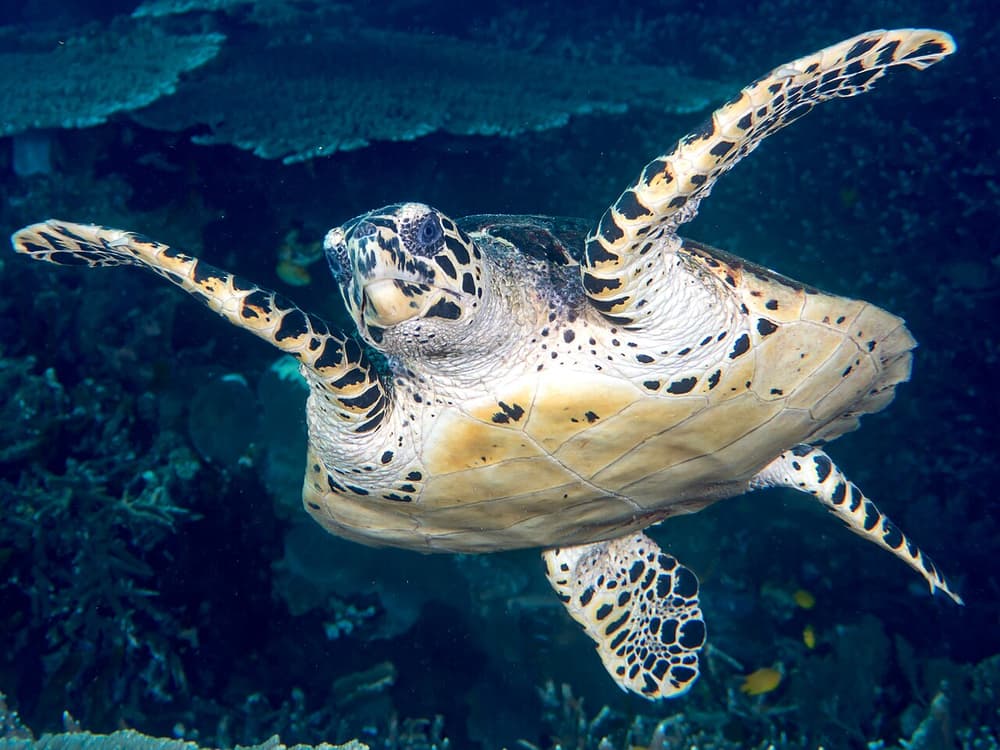
The star attraction is the sea turtle. Green turtles and hawksbills live here in remarkable numbers, protected by local agreement for decades; it is unusual to snorkel for an hour and not see one. Around them is the supporting cast of an Indonesian reef: angelfish, parrotfish, moray eels, cuttlefish, lionfish, black- and white-tip reef sharks, and now and then a passing manta ray.
It is fair to add that the shallow coral has suffered — from dynamite fishing before tourism, from anchors, from warm-water bleaching events and from the 2018 earthquakes. Some areas are rubble; others are recovering well, helped by restoration projects. Deeper reefs are in better shape than the snorkelling shallows.
Snorkelling from the beach
You can see turtles on all three islands without paying for anything but a mask.
| Spot | Island | What you see | Tips |
|---|---|---|---|
| Turtle Point (north-east coast) | Gili Trawangan | Green and hawksbill turtles on the reef edge, reef fish | Walk north, drift south with the current; best mid to high tide, mornings |
| Nest statues (west coast) | Gili Meno | 48 life-size figures in about 4 m, fish, soft coral growth | 30–50 m off the beach in front of BASK; before 8 am or after 4 pm |
| Turtle reef / Meno Wall (north-west) | Gili Meno | The most reliable turtles in the Gilis; a drop-off | Can have strong current; confident swimmers only, or go by boat |
| East-coast reef | Gili Air | Turtles on the edge, parrotfish, coral bommies | Enter in the north-east and drift south; too shallow at low tide |
| North coast | Gili Air | Coral gardens, fewer people | Check the current with a dive shop first |
| Bounty wreck (south-west) | Gili Meno | Sunken pontoon covered in coral, schooling fish | Best by boat; top at about 5–8 m |
Shore-snorkelling sense
- Read the current before you get in: watch which way moored boats point, or ask. Start up-current and drift.
- Mind the tide. At low tide the reef flat is ankle-deep and you will damage coral, and yourself, walking over it. Go at mid to high water.
- Stay out of boat lanes and wear something bright. A cheap inflatable marker buoy is a good idea.
- Never snorkel alone, and never try to cross a channel.
Snorkelling boat trips
The three-island boat trip is the Gilis’ signature excursion. A typical circuit takes three to five hours and stops at a turtle area, the Nest statues and a coral garden, with a lunch break on Gili Meno or Gili Air.
- Public or shared boats are very cheap, sociable and can be crowded, with fixed stops and short swims.
- Small-group trips cost a little more for fewer people and a guide in the water.
- Private boats let you choose the time — go at 7.30 am and you will have the statues before the fleet arrives — and linger where it is good.
- Sunset and catamaran trips trade snorkelling time for comfort and views.
Well-reviewed options from each island are on the tours pages for Gili Trawangan, Gili Meno and Gili Air.
Nest: the Gili Meno statues
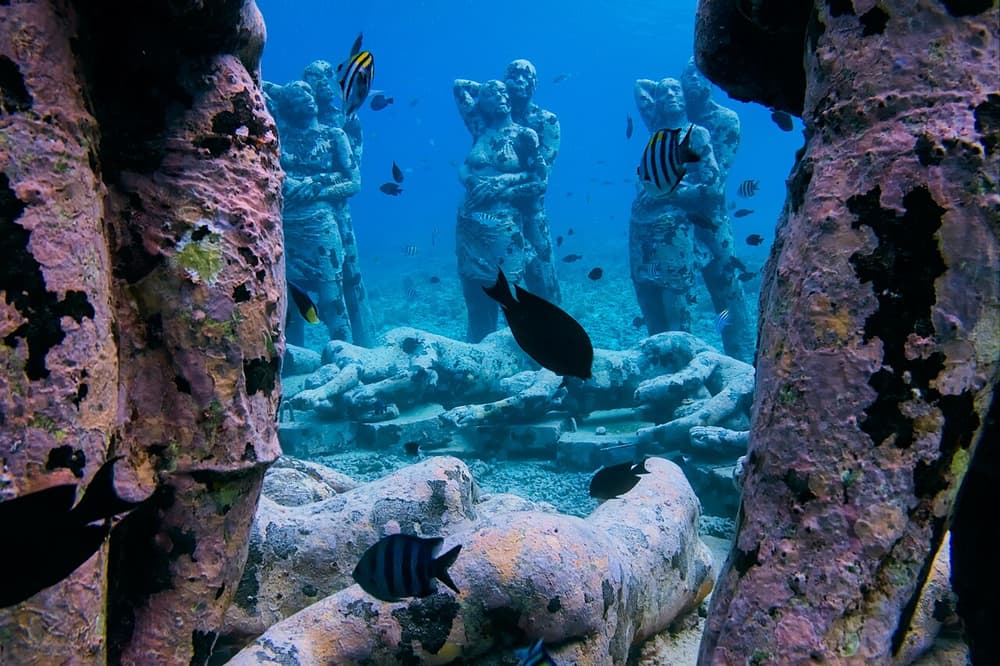
Nest is a circle of 48 life-size human figures — some standing in an embrace, others curled on the seabed — created by the British sculptor Jason deCaires Taylor and installed in 2017 just off the west coast of Gili Meno, in front of the BASK resort. The figures were cast from real people in a pH-neutral cement designed to encourage coral growth, and they are slowly becoming an artificial reef, fuzzed with soft corals and sponges and patrolled by batfish.
They stand in only about four metres of water, so snorkellers see them clearly and freedivers can swim among them. That accessibility is also the problem: in the middle of the day dozens of boats circle the site and hundreds of people float above it. Go early or late, look but do not touch or stand on the sculptures, and watch out for propellers.
The best dive sites
Dive centres on all three islands visit the same sites, choosing each day’s according to current and conditions.
| Site | Near | Depth | Level | Known for |
|---|---|---|---|---|
| Shark Point | Trawangan (west) | About 8–30 m+ | All levels; deeper ridges for advanced | Reef sharks, turtles, rays, schooling fish on stepped ridges |
| Halik | Trawangan (north) | About 5–35 m | All levels | Sloping coral reef, turtles, drift dives |
| Manta Point | Trawangan (south) | About 8–24 m | All levels | Wide coral plateau; mantas occasionally in season |
| Deep Turbo | Between Trawangan and Meno | About 18–32 m | Advanced | Sea fans, sand channels, garden eels, big scenery |
| Meno Wall | Meno (west) | About 5–18 m+ | All levels | Turtles, soft corals, a favourite night dive |
| Bounty Wreck | Meno (south-west) | About 6–18 m | All levels | Sunken pontoon smothered in coral, frogfish, glassfish |
| Simon’s Reef | North of Meno | About 15–35 m | Advanced | Healthy deep coral bommies, fewer divers |
| Han’s Reef | Air (north-east) | About 5–24 m | All levels; training | Macro life: frogfish, pipefish, seahorses |
| Air Wall | Air (west) | About 5–30 m | All levels | Soft-coral wall, turtles, scorpionfish |
| Japanese Wreck | Off the Lombok coast | About 45 m | Technical | A Second World War patrol boat for trained tec divers |
Depths are approximate. Currents can be strong on the outer sites, and many dives are done as drifts with the boat following.
Learning to dive
The Gilis are among the most popular places in the world to learn. The water is warm and clear, training sites are a few minutes from the classroom, and instruction is available in many languages. Schools teach PADI, SSI and other agencies’ courses.
- Try-dive (Discover Scuba): a half-day with a pool or shallow-water session and one supervised dive. No certificate, no commitment.
- Open Water: the full beginner’s certificate, usually three to four days.
- Advanced, Rescue and Divemaster: the islands, Trawangan especially, are a major centre for professional training.
- Technical diving and rebreathers: available at specialist centres.
Prices are fixed island-wide. Dive shops belong to a local association that sets common minimum prices and funds reef protection through the Gili Eco Trust, so there is no point shopping on price. Choose instead on group size, the condition of the equipment, how the briefing feels, and whether you like the instructor.
Safety: answer the medical questionnaire honestly, do not dive with a cold, and leave 18–24 hours before flying. The nearest recompression chamber is on Lombok.
Freediving
Deep water close to shore and little current on the sheltered sides make the Gilis a freediving centre too. Schools on Gili Trawangan and Gili Air run one-day introductions and multi-day courses under AIDA, SSI and Molchanovs systems, with pool or shallow sessions followed by line training on a buoy over 20–40 metres. Many combine it with yoga and breath-work. Even a single day transforms how comfortable you feel snorkelling down to the Nest statues.
Conditions through the year
- May–November: best visibility, calm seas, cooler thermoclines at depth in August–September.
- December–April: warmer water, more plankton, reduced visibility on some days, occasional mantas. Surface can be choppy on the west sides.
- Water temperature: 27–30°C. A shorty or 3 mm suit is ample; many people dive in a rash vest.
- Currents: strongest around full and new moon. Dive centres plan around them.
Turtle and reef etiquette
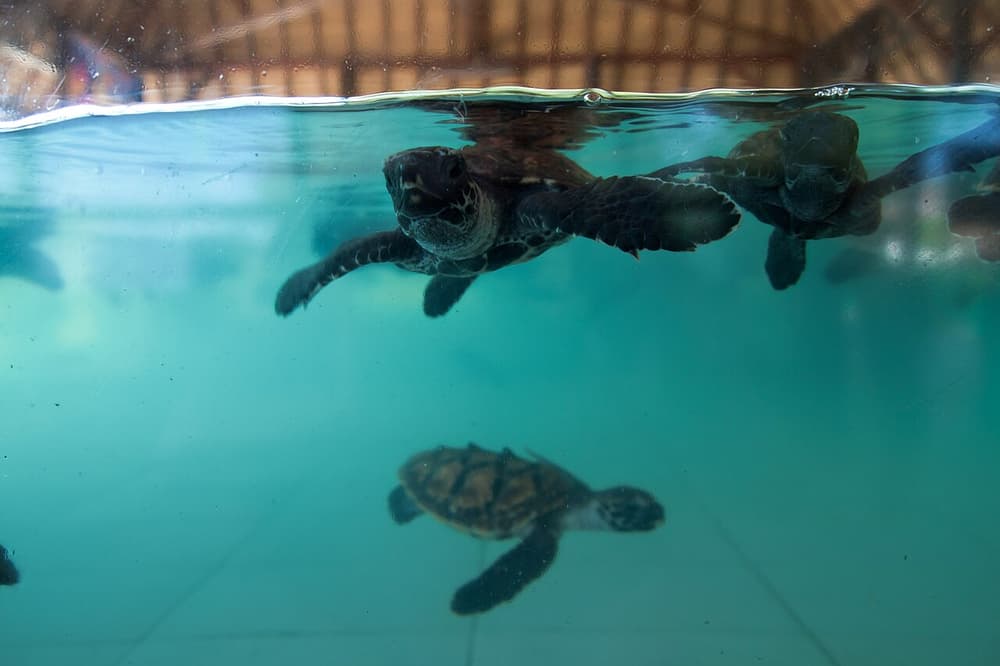
- Do not touch, chase, ride or block turtles. They must surface to breathe; give them a clear path up.
- Keep at least two or three metres away and let them come to you. They often do.
- Do not stand on or kick coral. If you need to rest, float.
- Do not feed fish.
- Use a rash vest instead of sunscreen where you can; choose mineral, reef-safe sunscreen where you cannot.
- Take nothing — no shells, no coral, no “souvenirs”.
- Speak up. If a guide grabs a turtle for a photograph or drops anchor on coral, say something and mention it in your review.
The Gili Eco Trust, a local non-profit, runs Biorock reef-restoration structures, mooring buoys, beach cleans and waste projects, funded partly by a small contribution from every diver. Visitors can join weekly clean-ups.
Beyond the three islands
For quieter reefs, the Secret Gilis off south-west Lombok have healthy shallow coral and almost no boats. From Bali, the Nusa Penida and Amed stopovers add manta rays, seasonal mola-mola and the Liberty wreck at Tulamben to a trip.