- Entry, visas and levies
- Money, cash and costs
- Safety: the honest list
- Health and insurance
- Etiquette on three Muslim islands
- Water, plastic and the islands’ limits
- Connectivity and power
- Food and drink
- What to pack
- Families and accessibility
Entry, visas and levies
The Gilis are part of Indonesia, in the province of West Nusa Tenggara (Nusa Tenggara Barat). Most visitors arrive through Bali or Lombok airports.
- Visa on arrival. Citizens of many countries — including most of Europe, the UK, Australia, the USA and Canada — can buy a 30-day visa on arrival, extendable once for a further 30 days. It can be obtained online in advance as an e-VOA, which shortens the queue. Nationals of some neighbouring countries enter visa-free. Rules and fees change; check Indonesia’s official immigration website before you fly.
- Passport. At least six months’ validity on arrival and a free page.
- Arrival declaration. Indonesia uses an online arrival and customs declaration to be completed shortly before landing; your airline will point you to the current form.
- Bali tourist levy. International visitors entering Bali pay a one-off provincial levy, online or at the airport. Lombok and the Gilis do not charge it, though small local harbour or arrival fees are collected in cash.
Money, cash and costs
The currency is the Indonesian rupiah (IDR). Prices everywhere on the islands are in rupiah, with many zeros: get used to thinking in thousands.
- ATMs exist on all three islands — several on Trawangan, a few on Air, very few on Meno. They run out of cash, go offline or refuse some foreign cards, especially in peak weeks. Withdraw on Bali or in Mataram or Senggigi before you cross, and keep a reserve.
- Cards are accepted by larger hotels, dive centres and smarter restaurants, typically with a surcharge of around 3%. Warungs, small guesthouses, public boats and harbour fees are cash only.
- Money changers on the islands give poorer rates than Bali; count your notes carefully.
- Tipping is not obligatory. Rounding up, or 5–10% for good service where no service charge is added, is appreciated. Tip dive guides, boat crews and trekking porters.
| Travel style | What it looks like | Rough daily budget per person |
|---|---|---|
| Budget | Homestay or hostel inland, warungs and night market, shore snorkelling, public boats | About €25–40 |
| Mid-range | Air-conditioned bungalow with pool, restaurant meals, a boat trip or class most days | About €60–120 |
| Comfort | Beachfront resort or private-pool villa, diving or private boats, cocktails at sunset | €150 and up |
These are loose guides for the islands themselves, excluding the journey there. High season adds 30–50% to rooms. Diving is priced separately and uniformly across each island.
Safety: the honest list
The Gilis are a safe destination by any reasonable measure, and violent crime against visitors is rare. The real risks are specific and avoidable.
Adulterated alcohol
Methanol poisoning from tainted spirits has killed and blinded tourists in Bali, Lombok and the Gilis. The danger lies in cheap cocktails and unlabelled local spirit (arak) poured from unbranded bottles. Drink beer, wine or spirits you have seen poured from a sealed, branded bottle; be suspicious of very cheap “happy hour” mixes and free shots. Early symptoms — severe headache, vomiting, blurred vision 12–24 hours later — are a medical emergency.
Drugs
Magic mushrooms and other drugs are offered openly on Gili Trawangan. All are illegal in Indonesia. Penalties are severe, including long prison sentences, and occasional police operations do take place. The absence of a visible police presence is not permission.
The sea
Currents between the islands are strong and have swept away confident swimmers. Never try to swim from one island to another. Snorkel with a buddy, stay inside the reef edge, and keep clear of boat lanes near the harbours.
Petty theft
Opportunistic theft from unlocked rooms, beach bags and bicycles happens. Lock up, use the safe, and do not leave phones on the sand while you swim.
Bikes and carts at night
There are few lights. Carry a torch, walk at the edge of the lane, and do not cycle after drinking.
Women travellers
Solo women travel here in large numbers and mostly without problems. Usual precautions apply late at night around the bars: watch your drink, and walk home with others on unlit paths.
Earthquakes
Lombok is seismically active and the islands were badly shaken in 2018. Know the way to open ground — and on Trawangan, to the hill. Our account of the 2018 earthquakes explains what happened and what it means for visitors.
Health and insurance
- Medical care. Each of the larger islands has small clinics that deal with cuts, coral scrapes, ear infections and stomach upsets. Anything serious means evacuation by boat to hospitals in Mataram on Lombok, or onward to Bali.
- Insurance covering medical evacuation is essential. Check that it covers scuba diving to the depth you intend, motorbike riding if you will do it on Lombok, and trekking to altitude if you plan to climb Rinjani.
- Divers. The region’s recompression chamber is on Lombok. Dive conservatively and do not fly for 18–24 hours afterwards.
- Stomach. Do not drink tap water. Ice in established restaurants is generally factory-made and safe. Wash hands often.
- Mosquitoes. Dengue fever occurs in Indonesia, including the islands. Use repellent at dawn and dusk. Malaria risk on Lombok is generally considered low but not zero in rural areas; ask a travel clinic for current advice.
- Sun and coral. The equatorial sun burns in twenty minutes. Wear a rash vest for snorkelling, and clean coral cuts thoroughly — they infect easily.
- Vaccinations. See a travel clinic four to six weeks before departure for current recommendations.
Etiquette on three Muslim islands
The islanders are overwhelmingly Muslim — Sasak from Lombok, with Bugis and other families who settled generations ago. They are welcoming and used to visitors, and they ask for very little in return.
- Dress. Swimwear is for the beach and pool only. Put on a shirt, sarong or shorts when you walk through lanes, shops and the village. Topless sunbathing is not acceptable anywhere.
- Mosques. The call to prayer sounds five times a day, the first before dawn. It is part of island life; earplugs solve the 4.30 am one.
- Ramadan. Tourist restaurants and bars stay open. In local areas, avoid eating, drinking and smoking in the street during daylight, and expect music to be quieter. See when to go for dates.
- Alcohol is freely sold in tourist venues; drunkenness in village lanes is resented.
- Public affection. Keep it modest.
- Photographs. Ask before photographing people, especially women and children.
- Left hand. Give and receive with your right.
- Bargaining is normal for souvenirs, boat charters and cart rides, but not in shops and restaurants with marked prices. Smile; it is a conversation, not a contest.
Water, plastic and the islands’ limits
Three sand islands with thousands of visitors a day have no rivers and little room for rubbish. Fresh water is barged in, desalinated or drawn from fragile wells; waste has to be shipped out or burned. You can help in small, real ways:
- Carry a reusable bottle and use the refill stations offered by many cafés, hotels and dive centres.
- Take short showers, and do not be surprised by slightly salty water in simpler rooms.
- Refuse plastic bags and straws.
- Use reef-safe sunscreen, or better still a rash vest.
- Take batteries and other hazardous waste back to the mainland.
- Join a beach clean — the Gili Eco Trust and several dive shops organise them weekly.
Connectivity and power
- Mobile data. Coverage is good on all three islands; Telkomsel generally has the strongest signal. Buy a tourist SIM or eSIM on arrival in Bali or Lombok — registration requires your passport.
- Wi-Fi is standard in hotels and cafés and adequate for calls and remote work, with occasional drops.
- Electricity is 230 V with two-round-pin European-style sockets (types C and F). Short power cuts occur; a power bank and a torch are useful.
Food and drink
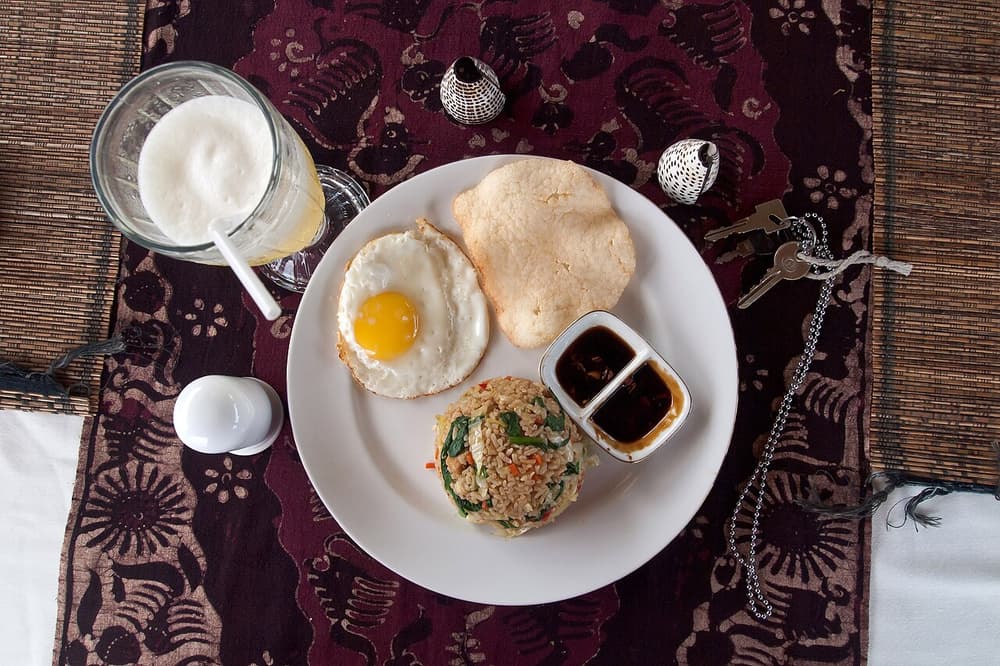
Island menus cover everything from Indonesian staples to pizza, poke bowls and vegan brunch. Look for Lombok’s own dishes: ayam taliwang (spicy grilled chicken), plecing kangkung (water spinach with chilli-tomato sambal), sate of fish or beef, and nasi campur, a plate of rice with several small dishes. Fresh fish is grilled every evening along the beaches and at Trawangan’s night market.
The islands are Muslim, so pork is uncommon outside tourist restaurants. Vegetarians and vegans are well catered for, especially on Gili Air. Sasak food is hot: “tidak pedas” means “not spicy”.
What to pack
- Reef shoes or sandals that can get wet — for low-tide reef flats and beach boat landings
- Your own mask and snorkel if you have them
- Rash vest, hat, sunglasses and high-factor reef-safe sunscreen
- A dry bag for boat days
- A torch or head torch
- Insect repellent and a small first-aid kit with antiseptic
- Seasickness tablets
- A light cover-up or sarong for the village
- A backpack or soft bag rather than a wheeled suitcase — the lanes are sand
- Cash in rupiah, in small notes
Families and accessibility
Families. The islands are excellent for children who like the water: no traffic, shallow seas on the east coasts, pools at many hotels. Bring reef shoes, children’s life vests if you have them (boat-supplied ones are often adult-sized), and any medicines you rely on. Gili Air and the quieter parts of Trawangan suit families best.
Accessibility. This is a difficult destination for wheelchair users and anyone unsteady on their feet. Boats are boarded from beaches or steep steps, paths are sand or uneven paving, and few hotels have step-free rooms. Gili Air’s jetty and the paved eastern lane on Trawangan are the easiest surfaces. Contact hotels directly and consider a private boat, whose crew can take time over boarding.